
SSWR DSC Monitor: SSWR 2026
This issue highlights transformational change and showcases PhD students’ research contributions at SSWR 2026.

Image Description: Image depicts various groups of people in business and business casual clothing talking and walking throughout the lobby of the Marriott Marquis Washington DC during SSWR 2024 conference. In the foreground, there are pillars with photos historical buildings printed on them, which connect to the white ceiling. The lobby opens up into an expansive atrium, with modern white and grey architecture in the background. The floors are white tile detailed with thick black lines in an abstract pattern.
This issue includes
Breaking the Outcome Addiction by Chenyu Zhao (She/her)
Reflections from the Candidacy Exam Process by Yujeong Chang (She/her)
The Power of Student Feedback: Transforming Higher Education, One Evaluation at a Time by Marsha McDowell (She/they)
Doctoral Student Presentations at SSWR 2026 Annual Conference
SSWR Doctoral Student Social
Doctoral Student Spotlights: Celebrating Doctoral Students’ Accomplishments

Breaking the Outcome Addiction
Chenyu Zhao (She/her)
Image Description:
Image depicts a white keyboard with a notebook in front of it. There’s a black marker on the notebook, and “TAKE A BREAK” written on it.
Breaking the Outcome Addiction
I’ve spent the past few years unlearning the idea that my worth depends on achieving a specific outcome, whether that meant becoming a professor in a foreign country, publishing a certain number of papers, or meeting a career timeline I set for myself. For most of my life, I viewed milestones as proof of my value. Academia reinforces this mindset by tying your worth to the next acceptance, award, or line on the CV. Before graduate school, I moved through several other institutions, and the same pattern appeared everywhere. People were rewarded for chasing markers, not meaning.
Rather than disengaging from ambition, loosening my grip means separating my sense of worth from uncertain academic outcomes. Letting go has also changed how I interact with others. When I am not focused on achieving a specific goal, I am more present in conversations, more curious, and more willing to collaborate without worrying about how it will benefit me. Relationships shift from transactional to generative. I approach colleagues and mentors by asking what we can create or solve together instead of what I can gain. Over time, this can foster healthier academic communities.
Paradoxically, I accomplish more this way. My writing becomes stronger, my thinking clearer, and I choose projects that truly align with a sense of purpose rather than just padding my résumé. Setbacks don't derail me because nothing relies on a single outcome. The system's volatility becomes something I can navigate rather than fear.
I don’t have this all figured out. I still slip back into old habits and catch myself comparing timelines or worrying about outcomes that don’t matter as much as I think they do at the moment. Letting go isn’t a breakthrough or a switch that stays flipped. It’s more like a small, ongoing correction, the mental version of noticing you’re slouching and deciding to straighten up your posture. It’s not perfect, but it’s enough to make the work feel more grounded and sustainable.

Reflections from the Candidacy Exam Process
Yujeong Chang (She/her)
Image description: Image depicts a pile of books that are opened to random pages. The books are laid out semi-overlapping.
Reflections from the Candidacy Exam Process
Across doctoral programs, the candidacy exam goes by many names (e.g., preliminary exam, comprehensive exam, qualifying exam) and varies widely in format. In my program, students choose between two options: a grant-writing option or a four-question option. I selected the four-question option. This option begins with the preparation of a research brief that outlines the student’s population of interest, substantive area of research interest, theoretical influences, research methods of interest, and practice/policy of interest. Based on this brief and a meeting in which the student presents and discusses it with the committee, each committee member develops one exam section aligned with their area of focus: specialization, theory, methods, or practice/policy implications. Each section comprises a set of in-depth, at times intensive, questions developed by the assigned committee member. These prompts require substantial literature review, synthesis, and critical thinking. Each section typically requires a 20-25 page written response. After completing the written components, students complete a two-hour oral exam with their committee, during which they are asked to clarify, defend, and extend their written work.
When I began preparing for the exam, I approached it as a process of finding the “right” answers to the questions I was given. I treated each section as a problem to solve, assuming there was a correct response I needed to identify or a response that my committee members wanted to see. As the process unfolded, it became clear that the exam was not structured around fixed answers. Instead, it required me to articulate how I think, justify my decisions, and explain the logic behind my scholarly thinking and the choices I made.
Preparing for the written exam required sustained engagement across theory, methods, and practice/policy. The challenge was not the volume of material, but the need to integrate it. I had to be explicit about why my area of interest mattered, why I was drawn to certain research questions, why I relied on particular theoretical frameworks, and how my methodological decisions aligned with my values as a social work researcher. The process pushed me beyond summarizing existing literature and toward taking ownership of my scholarly position.
One of the most important lessons I learned was that change often happens through narrowing rather than expanding. My research brief was broad and ambitious, but the candidacy exam questions from my committee helped me identify the central focus of my research agenda. Letting go of less essential ideas strengthened the clarity of my work and sharpened its focus. For example, I initially wanted to address multiple related questions across theory, methods, and practice. What ultimately helped me narrow my scope was returning to a single core research question and asking which components were most critical to address at this stage of my training. I also considered how the candidacy exam could serve as a foundation for my longer-term research agenda, prioritizing questions that would both be feasible in the present and generative for future studies. This process required setting aside several compelling but tangential ideas, which ultimately allowed the work to be more coherent and intentional.
The oral exam reinforced this shift in a more demanding way. It was intense and required me to move beyond what I had already written in the exam responses. Rather than revisiting my written work, the discussion pushed me to think in real time, respond to challenges, and extend my arguments. While evaluative, the oral exam was also constructive. It surfaced critical points I needed to carry forward, prompted me to reconsider assumptions I had not fully examined, and highlighted areas for further development in my thinking.
I do want to note that what made this intensity of the candidacy exam possible (and productive) was my committee. The questions were challenging because they were carefully tailored, thoughtful, and grounded in a deep understanding of my work. Even when the discussion was demanding, it felt generative rather than adversarial. I felt both pushed and supported, and that balance created space for genuine learning rather than performance.
Although the candidacy process is often experienced individually, it is deeply relational in nature. I am grateful to my committee members for their guidance, careful feedback, and willingness to engage seriously with my work. Their questions and support challenged me to move from searching for answers to taking responsibility for my thinking, which was central to the growth that occurred through this process.
Ultimately, the candidacy exam changed how I understand my role as a doctoral student. It was less about demonstrating that I had mastered a body of knowledge and more about showing how I reason, make decisions, and stand behind my work. That shift, from answering questions to owning them, is where I think transformational change begins.

The Power of Student Feedback: Transforming Higher Education, One Evaluation at a Time
Marsha McDowell (She/they)
Image depicts three wooden blocks on a white surface against a light blue background. The block furthest from the viewer has a frowning face, the middle block has a neutral face, and the closest block has a smiling face, all drawn in black.
The Power of Student Feedback: Transforming Higher Education, One Evaluation at a Time
Starting a new semester in higher education always brings its own set of challenges, but this year feels especially complicated. Universities are under fire for championing progressive ideas and research. On top of that, many of us are dealing with the fallout from the Department of Education’s decision to reclassify certain professional degrees, making it hard not to question whether our work and ambitions are being taken seriously. However, as students in the field of social work, it is our right and our duty to stay involved in making change, no matter how big or small. Keeping in mind our own limitations and needs, participating in transformative change can happen in many ways. An effective form of change is direct feedback to professors and administrators through completing course completion evaluations. Don’t underestimate the hidden influence of course evaluations and the power of student feedback. This is not to say that students should point out every pro and con of a course. However, if something about the course particularly stands out to you, good or bad, the feedback provided through speaking up can be the beginning of real transformative change.
Considering that many professors see themselves as life-long learners, evaluations are important tools for professors to make improvements in their courses, but also to see what is working well. The more detail that can be provided, the more information the faculty has to determine how to structure their next course. Furthermore, colleges can analyze trends in feedback to inform decisions to update course materials and learning outcomes. Importantly, evaluations can be used to analyze students’ academic experience, whichthat, when taken seriously by administration, can transform student engagement and motivation. Positive student engagement and motivation can result in improved retention rates and increased enrollment, further benefiting the entire college ecosystem.
Course evaluations aren’t only a tool for professors, and they offer real value to students as well. Filling one out gives you the opportunity to pause, look back on the course, and consider what you actually learned, how far you’ve come in your degree, and what obstacles you faced along the way. It’s a built-in moment for honest reflection and self-assessment. Additionally, evaluations give you a chance to practice giving constructive feedback in a professional manner. When worded in a respectful way, negative feedback can provide valuable insight to professors and administrators for improving the course. It’s important to acknowledge that not every course warrants glowing praise, and sometimes there are real issues that need to be brought to light. Course evaluations give students a structured, low-pressure way to raise concerns, which can be especially valuable for those who experience anxiety or have trouble speaking up in person. Advocacy doesn’t always happen face-to-face; in many cases, a well-articulated comment is what sparks meaningful change. Whatever the feedback is, evaluations offer a chance to practice writing in a professional and respectful manner, which will not only aid you while you are still in college, but the practice of providing feedback is essential for effective leadership and advocacy in your professional life.
Most importantly, completing honest and professional course evaluations is a practical way to remind yourself that your insights and feedback are valuable. Even when you’re surrounded by “experts.” It’s easy to forget, in fields as specialized as higher education and social work, that the student perspective has weight. But professors aren’t meant to exist in a vacuum. The ability and willingness to acknowledge and consider student feedback isn’t a sign of weakness in an instructor; it’s evidence that they take their role as educators seriously. When you submit your evaluation, you’re not just contributing to a pile of data points that sit on a spreadsheet; you’re participating in the ongoing conversation about what good teaching looks like in real life. Whether you’re noting strengths or pointing out what needs to change, offering your perspective through evaluations is like adding another data point to the ongoing experiment of teaching and learning. Each bit of feedback helps build a clearer, more accurate understanding of what truly supports student success. After all, even expertise itself benefits from challenge and revision. When professors and administration listen and adapt, everyone wins across the entire campus community. Your perspective, shaped by direct engagement with the course, offers valuable insight that cannot be replicated by external assessment alone. By providing well-considered feedback in course evaluations, you help ensure that your experiences and observations are considered and meaningfully inform future improvements.
SSWR 2026 Annual Conference
Image depicts a light blue background with a faded image of the US Capital building. Blue text on the image reads “SSWR Society for Social Work and Research 30th Annual Conference Anniversary. Leading for Transformative Change: Aligning Social work Science with Policy and Practice.
Doctoral Students at SSWR 2026
We sent out requests during November and December to gather a list of doctoral students presenting at SSWR 2026. We hope that this list can be used to foster connections and allow for more opportunities for networking among doctoral students.
Access the Google Sheets document compiling the responses that we received here.
SSWR 2026 Doctoral Student Social!
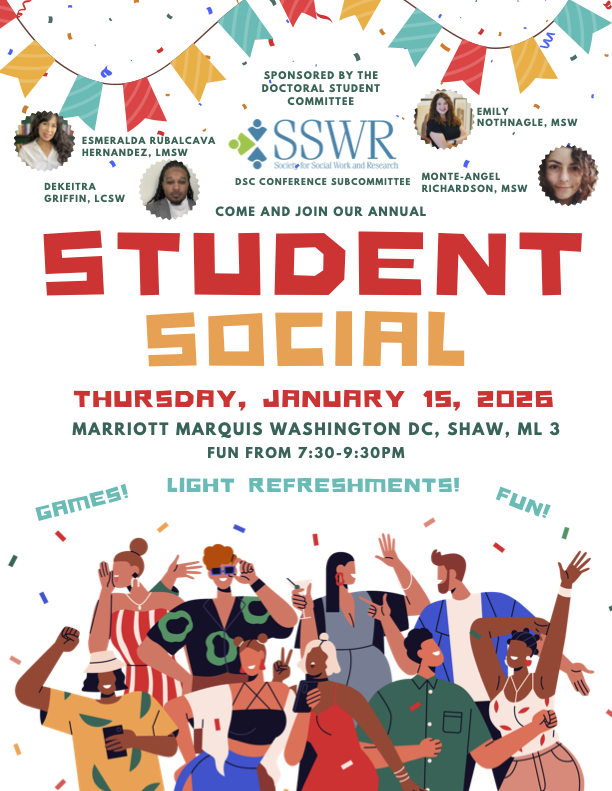
Join the SSWR DSC Conference Sub-Committee in their annual Student Social! The student social will be on Thursday, January 15 2026 in Marriott Marquis Washington DC.
The Student Social will be held in Shaw ML 3 from 7:30 until 9:30 PM. There will be games, refreshments and fun! The student engagement committee will be holding a meet and greet at the student social to connect with doctoral students and offer insight about ways to participate at SSWR.
Conference Sub-committee members depicted on the flyer include
Esmeralda Rubaclava Hernandez, LMSW (Conference Committee Co-Chair)
DeKeitra Griffin, LCSW (Conference Committee Co-Chair)
Emily Nothnagle, MSW
Monte-Angel Richardson, MSW

Doctoral Student Spotlight
Image depicts a non-binary person writing in an unlined, cream colored journal at a dark wooden desk. The persons head is out of focus, and only their right arm is visible. The person has tattoos on their right arm and wears a silver ring on their index finger.
Social Work Doctoral Student Accomplishments

Image depicts Yujeong, a Asian person with shoulder length brown hair smiling at the camera.
Congratulations Yujeong Chang (she/her)!
Yujeong is a PhD candidate at The Ohio State University, and she has a range of accomplishments to celebrate, including
Passing her candidacy exam!
Being selected as a student reviewer on the Student section of the Child Maltreatment journal's editorial board!
Publishing a first-authored paper in Child Maltreatment
Read Yujeong’s Paper
Chang, Y., Chang, O. D., Yang, J., Sattler, K., & Yoon, S. (2025). Patterns of protective factors following childhood maltreatment and youth developmental outcomes. Child Maltreatment.
Learn more about Yujeong
Yujeong is a PhD candidate at The Ohio State University College of Social Work. Her research interest focuses on examining the complex mechanisms and transactional processes of multi-level factors across the socio-ecological framework that shape the psychopathology and resilience of children and adolescents following experiences of child maltreatment.
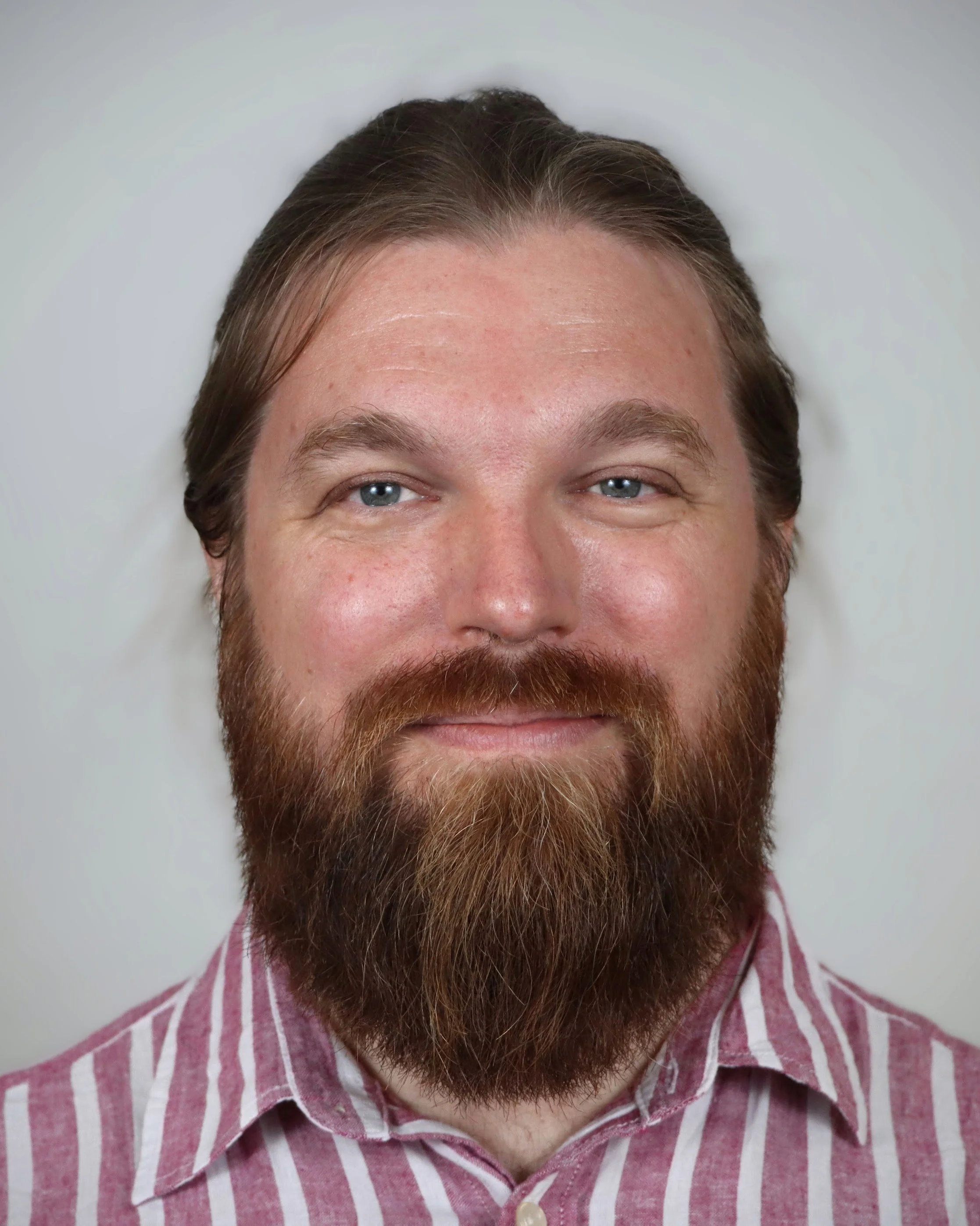
Image depicts Ian, a white person with a medium dark red beard smiling at the camera. Ian is front of a white background, with a white and rust colored striped shirt.
Congratulations Ian G. Williams (he/him)!
Ian recently contributed as an author for a special issue in Human Service Organizations: Management, Leadership, Governance.
I'd like to share a recent publication and project that came to fruition this fall. It's a collaborative piece, where I was the only doctoral student co-author, and it was a significant milestone for my learning goals, which include wanting to build interdisciplinary research communities and curate scholarly projects.
The culmination of several years of collaboration and building the Social Work Innovation Network (SWIN), a special issue of Human Service Organizations: Management, Leadership, Governance was published this November, in which I served as a guest editor for. The issue features thirteen articles representing the work of over fifty scholars, highlighting global perspectives on social work and human services from the lens of social innovation, social enterprise, and social entrepreneurship. As translational scholarship, it bridges work across disciplines and geographies, adding much-needed contributions to the social work research landscape around what is often referred to as the social economy.
The other co-authors and guest editors, Marissa Kaloga, PhD, MSW (Department of Management and International Business, University of Auckland Business School, Auckland, New Zealand), Dr. Monica Nandan, PhD, MSW (Wellstar College of Health and Human Services, Kennesaw State University), and Dr. James M. Mandiberg, PhD, MSW (Silberman School of Social Work at Hunter College and PhD Program in Social Welfare, The Graduate Center, City University of New York), are also co-founders and co-leaders of SWIN, and bring considerable expertise to this project. As a doctoral student, it was a significant accomplishment to work on this project from conceptualization of its CfP to its publication, and I think it is a good example of collaborative scholarship where doctoral students can make significant contributions in organizational development and project curation.
The introductory chapter of the full issue can be viewed here:
Kaloga, M., Nandan, M., Mandiberg, J. M., & Williams, I. G. (2025). Social Innovation, Entrepreneurship, and Enterprise in Social Work and Human Services: Recasting the Historical Evolution of a Global Phenomenon. Human Service Organizations: Management, Leadership & Governance, 49(5), 429–450.
You can also learn more by visiting SWIN's LinkedIn page.
Ian G. Williams, LMSW, is a doctoral student in Social Welfare at The Graduate Center, CUNY, where he also earned an Advanced Certificate in Interactive Technology and Pedagogy. He holds an MSW in Organizational Leadership and Management from the Silberman School of Social Work at Hunter College and a BA in East Asian Studies, Cultural Studies, and World Religions from McGill University.
Ian’s research examines technology adoption, innovation diffusion, and organizational behavior in human services and welfare states. Drawing on his multidisciplinary background in social work, digital humanities, and media studies, he is especially interested in the contested meanings of “Tech for Good” and how they manifest in digital literacy and civic technology initiatives. He is a founding member of the Social Work Innovation Network and an affiliate of the CUNY Public Interest Technology (PIT) Lab.
Ian’s human services experience spans immigrant and refugee mutual aid organizations in Vermont (AmeriCorps VISTA), supportive housing services in NYC (The Door, Breaking Ground), workplace mental health and disaster relief (NYC Employee Assistance Program), and behavioral health operations and data systems (Harlem Family Institute). He has also worked on technology and social welfare policy as a Policy Fellow with The Network for Social Work Management.
As an educator, Ian has taught courses on social welfare policy, homelessness, and professional seminar capstones at the Silberman School of Social Work, and facilitated digital skills workshops with The Graduate Center Digital Initiatives, where he currently serves as a Social Media Fellow.
Congratulations Sangmi Kim (she/her)!
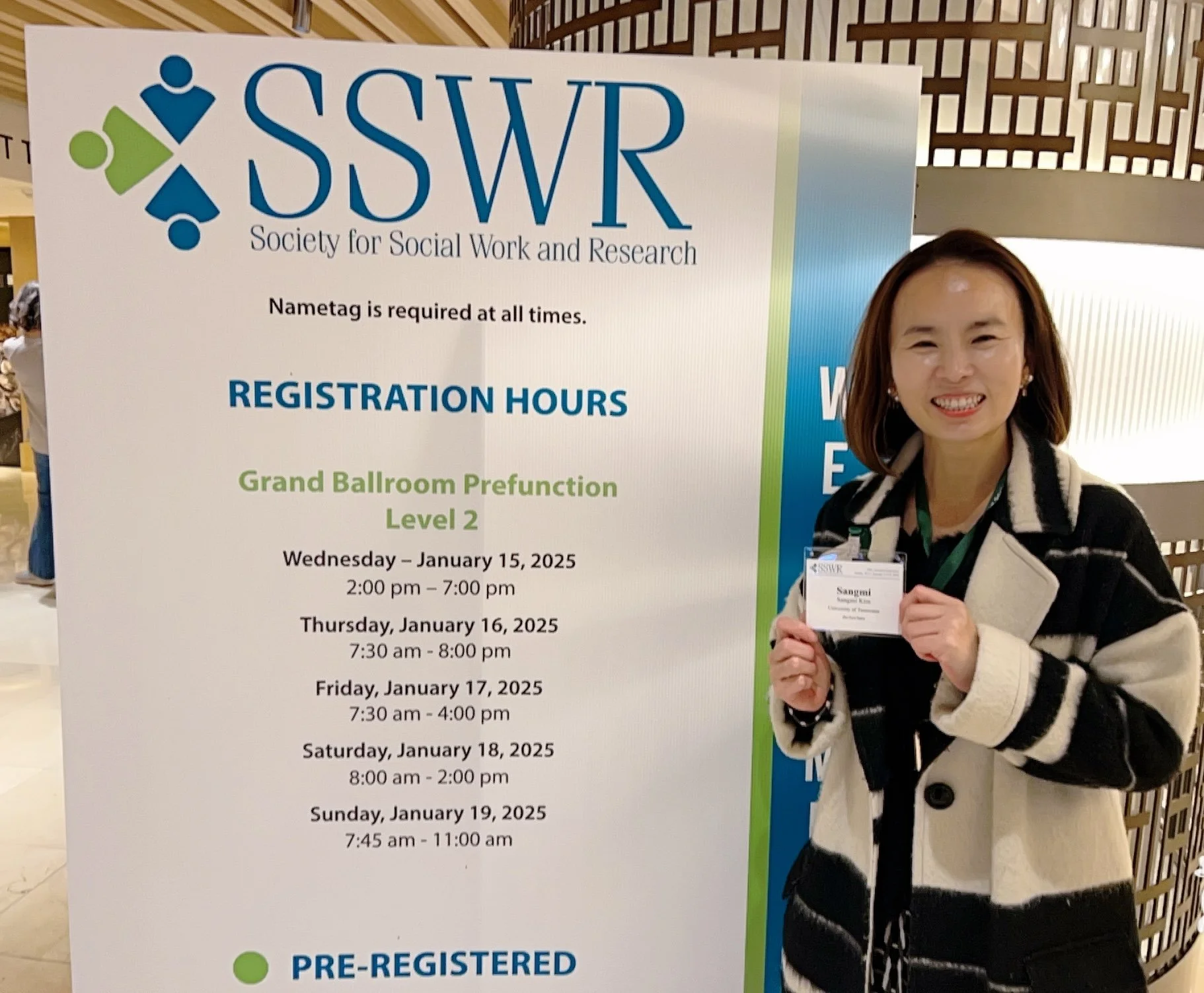
Image depicts Sangmi Kim, a Korean woman with straight shoulder-length hair, is smiling and holding her name badge while standing next to a large signboard for the Society for Social Work and Research (SSWR) 2025 Annual Conference. She is wearing a black-and-white patterned coat.
Sangmi Kim received the CSWE Doctoral Student Policy Fellowship 2025–2027, Tennessee Society of Health Care Social Workers Mid East Council Scholarship Award for 2025, and has received funding for her project CBPR-Based AI Digital Storytelling to Address Social Isolation and Prevent Suicide.
Sangmi Kim is a 3rd year PhD candidate at the University of Tennessee, Knoxville. Her research interests include suicide prevention, youth and young adult mental health, data justice, machine learning, and culturally responsive AI tools.
Here’s full information about her awards:
CSWE Doctoral Student Policy Fellowship 2025–2027. (August 2025). Council on Social Work Education (CSWE). Selected as a national CSWE Doctoral Student Policy Fellow, recognizing excellence in social work policy research and commitment to evidence-based advocacy.
TSHCSW Mid East Council Scholarship Award. (September 2025). Tennessee Society of Health Care Social Workers (TSHCSW), Mid East Council. Recognized for academic excellence and contributions to the field of health care social work. Honored at the Annual Ethics Conference 2025.
CBPR-Based AI Digital Storytelling to Address Social Isolation and Prevent Suicide. (October 2024–June 2025). Community Engagement Academy, University of Tennessee, Knoxville. Graduate Student Principal Investigator (with Dr. Robert Lucio as faculty advisor). Funded project award: $1,000. In June 2025, I successfully hosted an AI storytelling workshop, and this work was subsequently accepted for presentation:
Sangmi’s recent conference presentations:
Kim, S., Cha, G. E., Won, C. C., Jeong, S., & Lucio, R. (2025, October 1–2). Community-based AI digital storytelling for mental health support: A pilot study for Korean and Korean American adults [Poster presentation]. 8th Annual Engagement and Outreach Conference: Next-Level Engagement—Connect, Collaborate, and Cultivate, University of Tennessee, Knoxville, TN, United States.
Kim, S., Jung, G. S., & Kim, A. (2026, January 14–18). From thoughts to actions: Predicting suicidal ideation and attempts in youth using sex-based machine learning models [E-poster presentation]. 30th Annual Society for Social Work and Research (SSWR) Conference, Marriott Marquis, Washington, DC. In addition to serving as a presenting author, I also collaborated on four additional projects as a contributor.

DSC Call for Nominations: Doctoral Student Achievements
Image depicts several organs and white balloons with gold string in front of a bright blue background. The balloons are emerging from the bottom left corner of the photo.
Submit Nominations for Doctoral Student Achievements!
Celebrate doctoral students’ accomplishments in research, practice, and/or degree milestones!
SSWR DSC Communications Subcommittee has an ongoing call for nominations to showcase social work doctoral student achievements.Nominate a colleague (or yourself) to have their recent accomplishments featured on SSWR DSC social media and in a future DSC newsletter.
The nomination form asks for your name, pronouns, program, a description of the accomplishment(s), information about your research, and brief bio information. If you want, you can also upload a photo of the nominee for us to share and tell us your social media handles to mention in the posts. Student achievements will be posted to social media and the SSWR DSC website as they are received. Achievements will also be featured on the SSWR DSC Newsletter.
View past students showcased for their achievements here.
CLICK HERE TO NOMINATE A COLLEAGUE (OR YOURSELF) TO BE FEATURED

Social Work Snippets
RESOURCES FOR NEWER CONFERENCE PRESENTERS AND ATTTENDEES
How to Give a Scientific Talk: https://www.nature.com/articles/d41586-018-07780-5
Video on How to Confidently Present your Research at Conferences: https://asiaedit.com/webinar/how-to-confidently-present-your-research-at-conferences-in-person-and-online
Not following “SWRnet”?
Formerly known as the IASWR Listserv, SWRnet (Social Work Research Network) was launched in October 2009 to continue serving the social work research community by providing regular updates on funding opportunities, calls for papers, conference deadlines and newly published research. SWRnet is administered by the Boston University School of Social Work.
ADDITIONAL INFORMATION
Disclaimer: This newsletter is created as free service by SSWR Doctoral Student Committee Communications Subcommittee members.
The opinions expressed in this newsletter are the opinions of the individuals listed above alone and do not claim to represent the opinions of SSWR or the SSWR Doctoral Student Committee